

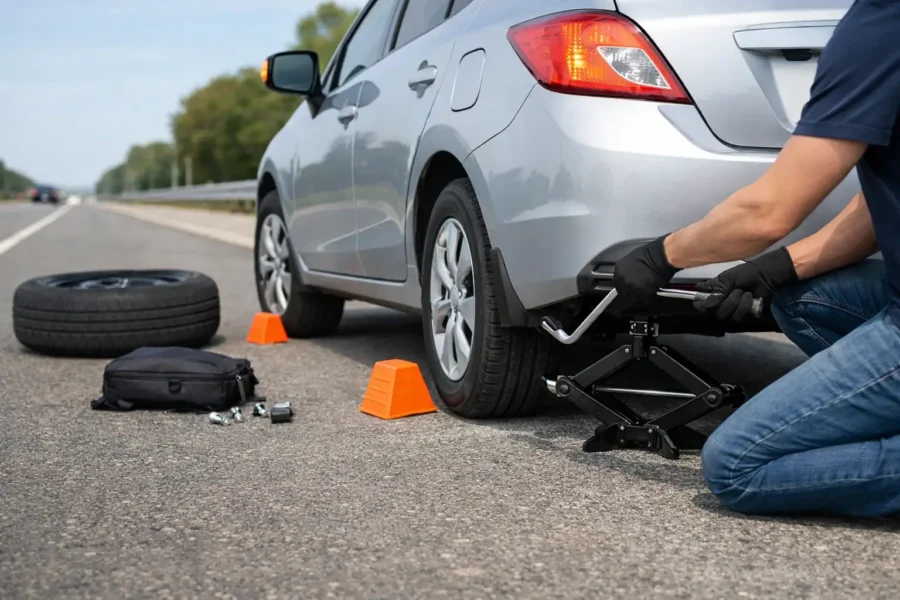
How to Change a Tire Safely: A Step-by-Step Guide for Cars and Bikes?
A flat tire always seems to happen at the worst time. Maybe you are late for work. Maybe it is raining. Or maybe you are on a quiet road with no help nearby. The good news is that learning how to change a tire is not complicated. You just need the right steps, a little patience, and a focus on safety.
In this guide from BitsyBiz, you will learn how to change a flat tire on a car, how long it usually takes, what it can cost at a shop, and how the process changes for bike tires. You will also see a few options depending on your situation, because not every tire change looks the same.
Why knowing how to change a tire matters
A tire can go flat from a nail, a sharp pothole, a leaky valve stem, or a slow puncture that finally gives out. If you know how to change a tire on a car, you can get back on the road without waiting for a tow.
There are two solid ways people handle a flat tire:
- Do it yourself with a spare tire so you can drive to a shop
- Call roadside help if it is unsafe, you do not have tools, or the tire damage is serious
Both approaches make sense. The right choice depends on your location, traffic, weather, and comfort level.
Tools you need to change a car tire
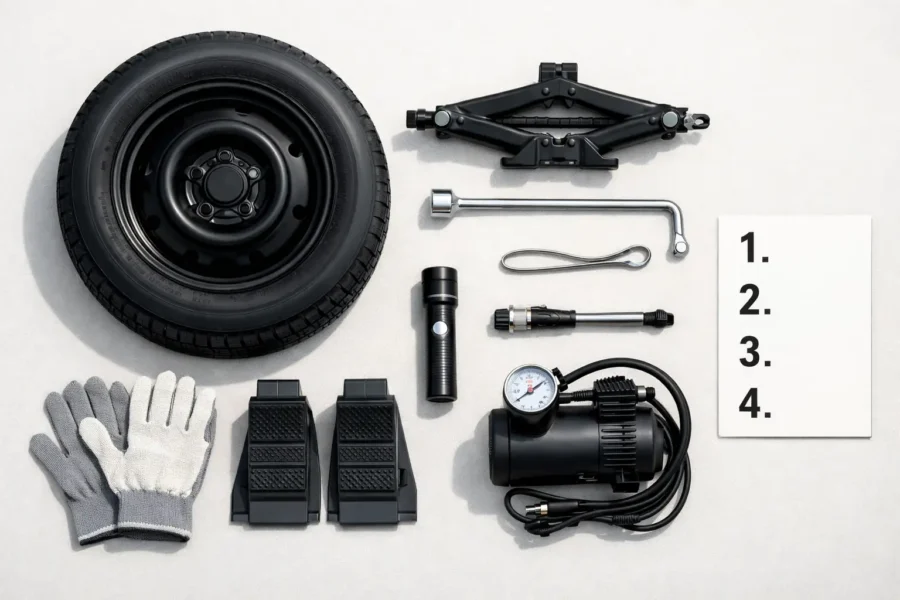
Before you start, make sure you have the basics. Most cars include these items in the trunk or under the cargo floor.
Basic car tire change kit
- Spare tire (temporary donut or full-size spare)
- Jack (scissor jack or bottle jack)
- Lug wrench (or tire iron)
- Wheel chocks (or a heavy object like a brick)
- Flashlight (especially at night)
- Gloves and a small towel
- Tire pressure gauge
If you want to be extra prepared, add a small air compressor and a reflective triangle.
Safety first: where and how to stop
If you are wondering how to jack up a car for tire change, safety starts before the jack even touches the car.
Pick the safest spot possible
- Pull over to a flat, firm surface
- Get as far from traffic as you can
- Turn on hazard lights
- If it is dark, use a flashlight and reflective gear if you have it
Secure the vehicle
- Put the car in Park (or in gear for manual)
- Set the parking brake
- Place wheel chocks behind the wheels that will stay on the ground
If you feel unsafe because of traffic, a narrow shoulder, or poor visibility, do not force it. Calling for help is often the smarter move.
How to change a tire step by step (car)
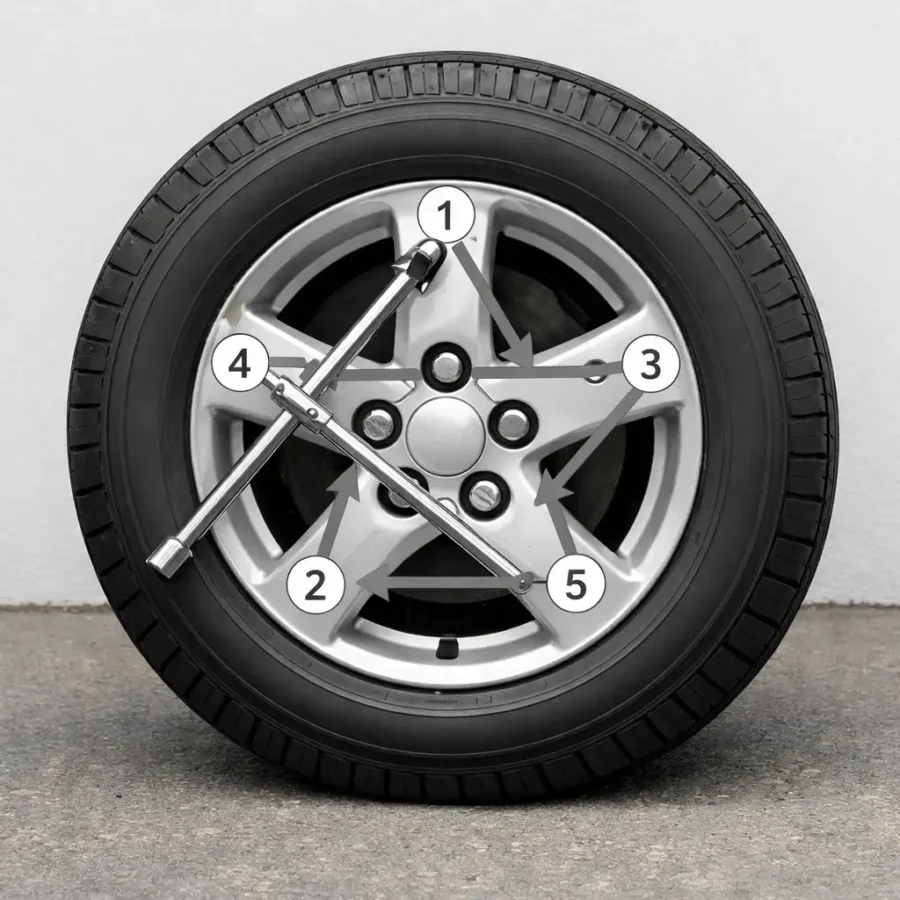
This is the practical how to change a tire step by step process most drivers use. If you want the cleanest approach, follow the order exactly.
1) Find the spare and tools
Open your trunk or cargo area and locate the spare tire, jack, and lug wrench. Some vehicles store these under a panel or in a side compartment.
2) Loosen the lug nuts before lifting the car
Use the lug wrench to break the lug nuts loose while the tire is still on the ground. Turn left to loosen. Do not remove them yet. Just loosen them about a quarter to half turn.
This matters because once the car is in the air, the wheel can spin while you try to loosen the nuts.
3) Place the jack at the correct lift point
Check your owner’s manual for the exact jack point. Most cars have reinforced pinch welds or marked areas near each wheel.
If you place the jack in the wrong spot, you can damage the car or cause the jack to slip.
4) Jack up the car
Raise the vehicle until the flat tire is a few inches off the ground. Make sure the car feels stable. If it wobbles, lower it and reposition the jack.
5) Remove the lug nuts and wheel
Now you can remove the lug nuts fully. Keep them together in a pocket or a small container so they do not roll away.
Pull the wheel straight toward you and set it flat on the ground. Setting it flat helps prevent it from rolling.
6) Install the spare tire
Line up the spare tire with the wheel studs. Push it on until it sits flush.
7) Hand-tighten lug nuts
Put the lug nuts back on and tighten them by hand first. This prevents cross-threading.
8) Lower the car and tighten lug nuts fully
Lower the car until the spare tire touches the ground, but keep a little weight off it so it does not spin.
Tighten the lug nuts in a star pattern:
- Top
- Bottom
- Left
- Right
- Repeat until snug
Then lower the car completely and tighten again firmly. This completes how to change a car tire step by step in the safest way.
9) Check pressure and drive carefully
If you have a gauge, check the spare tire pressure. Many spares run at higher pressure than regular tires.
If you installed a donut spare, drive slowly and avoid long trips. Go straight to a tire shop. That is the standard how to change a spare tire and how to change a car tire method.
Extra tips for changing a flat tire
Sometimes the basics are not enough. Here are a few real-life situations that come up often when people search how to change a flat tire step by step.
If the lug nuts are stuck
- Use your body weight on the wrench, pushing down carefully
- If possible, use a longer wrench for leverage
- Avoid sudden force that can slip and cause injury
If your tire is shredded or the rim is damaged
If you see sidewall tearing, bent metal, or severe damage, towing may be safer. A spare tire will not fix a damaged rim.
If you have a locking lug nut
Many cars have a special key for one lug nut per wheel. Keep that key in the car, not at home.
How long does it take to change a tire?
People often ask how long does it take to change a tire or how long to change a tire. The short answer depends on experience and conditions.
Typical time ranges
- First time doing it: 20 to 45 minutes
- With practice: 10 to 20 minutes
- Bad weather or unsafe shoulder: longer, or not worth attempting
If you are asking how long does it take to change a flat tire, the timing is usually similar. A flat tire takes longer only if lug nuts are stuck or the jack placement is tricky.
How long does it take to change a tire at a shop?
At a shop, you might spend 30 to 90 minutes total depending on the line, staffing, and whether they patch or replace the tire. The hands-on work is usually quick, but waiting time varies.
How much does it cost to change a tire?
Another common question is how much does it cost to change a tire or how much to change a tire. Cost depends on what “change” means in your case.
Common cost situations
- Swap on your spare: often free if you do it yourself, or included with roadside assistance
- Patch a repairable puncture: usually cheaper than replacement
- Mount and balance a tire: costs more because it includes labor and balancing
- Replace the tire: varies by tire size and vehicle type
People also ask how much is it to change a tire or how much does it cost to change a flat tire. If a tire is repairable, you may pay for a patch and balancing. If it is not repairable, you pay for a full replacement.
How to change a tire without a jack
If you search how to change a tire without a jack, you will find a lot of risky advice. In most real situations, you should not attempt this.
Safer alternatives without a jack
- Use roadside assistance
- Use a tow service
- If you are at home, use a proper jack and jack stands
Some off-road setups use special equipment, but that requires training and safe ground. For most drivers, no jack means no safe tire change.
How to change a tire on a rim (what people usually mean)
Many people say how to change a tire on a rim when they actually mean changing the wheel on the car. That is what the steps above cover.
If you mean removing the rubber tire from the metal rim and installing another tire, that is a different job. It usually requires a tire machine, bead breaker, and balancing equipment. Most people leave that work to a shop.
How to change a bike tire (tube and tubeless)
Bike tire changes depend on whether you have a tube or a tubeless setup. Learning how to change a bike tire gets easier after you do it once.
How to change a bicycle tire with a tube
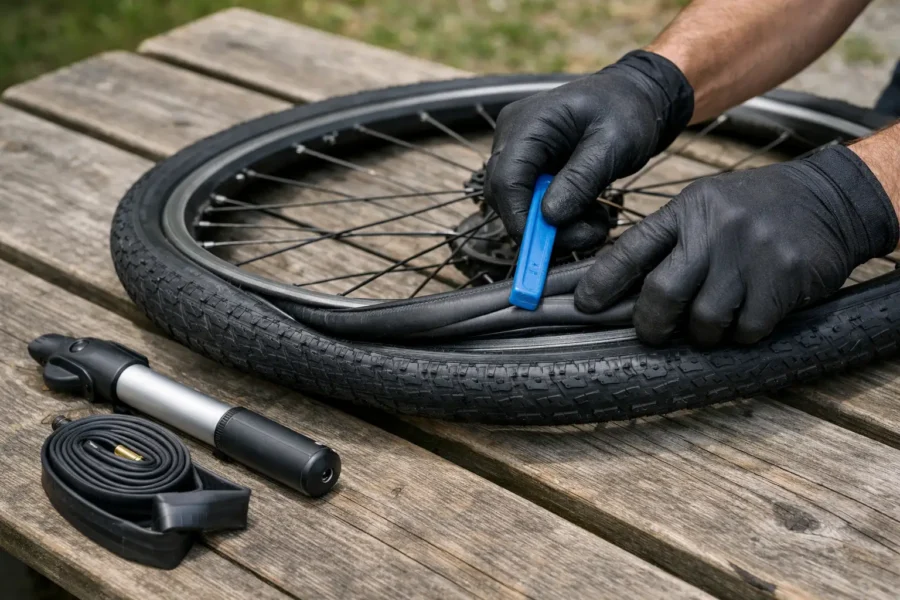
This method applies to many bikes including road, mountain, and commuter bikes. It covers how to change a bicycle tire and how to change a bike tire tube.
Tools you need
- Tire levers (plastic is best)
- Spare tube (correct size)
- Mini pump or CO2 inflator
- Patch kit (optional)
Steps
- Remove the wheel. For the rear, shift to the smallest gear first
- Release the brake if needed
- Use tire levers to lift one side of the tire off the rim
- Pull out the tube
- Check inside the tire for thorns, glass, or sharp edges
- Put a little air into the new tube so it holds shape
- Insert the tube and tuck it into the tire
- Push the tire bead back onto the rim by hand
- Inflate slowly and check that the tire sits evenly
This covers how to change a tire on a bike and works for many riders.
How to change a rear bike tire with gears
Rear wheels take longer because of the chain and derailleur. Shift into the smallest cog, pull the derailleur back, and guide the wheel out gently.
How to change a tubeless bike tire
If you searched how to change a tubeless bike tire or how to change a tubeless tire, it helps to know that tubeless setups often let you fix small punctures without removing the tire.
Here are two practical options:
- Plug and ride: for small punctures, a tubeless plug kit can fix it quickly
- Insert a tube: if the cut is large or sealant fails, add a tube as a backup after removing one bead
Other tire types people ask about
Not every tire change is on a sedan or a bicycle. Many readers look up searches like how to change a motorcycle tire, how to change a trailer tire, or how to change a tractor tire.
Here is the practical takeaway:
- Motorcycle tires often require tools for bead breaking and balancing, so most riders use a shop unless they have equipment
- Trailer tires can be changed like a car tire, but you must secure the trailer and use correct jack points
- Lawn mower, golf cart, and riding mower tires vary by design, so searches like how to change a lawn mower tire, how to change a golf cart tire, and how to change a tire on a riding lawn mower depend on the model
Tire sensors and valve stems: what to know
People ask how long does it take to change a tire sensor or how to change a tire pressure sensor. Tire pressure sensors usually sit inside the wheel. Replacing them often requires removing the tire from the rim, so shops typically handle it.
Another related search is how to change a tire valve stem. Valve stems can leak over time, but replacing one usually also requires removing the tire from the rim.
Common mistakes to avoid
These mistakes slow you down and can make the situation unsafe.
- Forgetting hazard lights
- Jacking on soft ground where the jack can sink
- Loosening lug nuts after lifting the car
- Losing lug nuts in grass or gravel
- Tightening lug nuts in a circle instead of a star pattern
- Driving too fast on a donut spare
If you want one simple rule, focus on stability first, then method, then speed.
Conclusion
A flat tire does not need to ruin your day. When you know how to change a tire step by step, you can handle the problem calmly and safely. You can also choose the smarter option when conditions are risky.
Keep your tools organized, check your spare tire pressure now and then, and practice once at home if you can. A quick practice run makes the real moment much easier. BitsyBiz recommends treating tire changes like any other basic skill. You hope you never need it, but you are glad you have it.
FAQs
How long does it take to change a tire?
Most people take 10 to 20 minutes with practice, but first-timers often need 20 to 45 minutes.
How long does it take to change a flat tire?
It usually takes about the same time unless lug nuts are stuck or the area is unsafe.
How much does it cost to change a tire?
Swapping to a spare can cost nothing if you do it yourself, but shop work like mounting and balancing costs more and varies by location.
How much does it cost to change a flat tire?
If the tire can be patched, it is often cheaper than replacing it, but severe damage usually means a new tire.
How to change a tire on a car step by step?
Loosen lug nuts, jack up the car at the proper point, remove the wheel, install the spare, then tighten lug nuts in a star pattern.
How to change a tire without a jack?
In most cases you should not try, and the safer option is roadside assistance or towing.
How to change a bike tire tube?
Remove the wheel, pop one side of the tire off with levers, replace the tube, then reseat the tire and inflate slowly.
How to change a tubeless bike tire?
For small punctures, use a plug, and for larger failures insert a tube as a backup after removing one side of the tire.
How long does it take to get a tire change at a shop?
You may spend 30 to 90 minutes total depending on wait time, even though the actual tire work is usually quick.
How to change a tire on a travel trailer?
Secure the trailer, chock the wheels, use the correct jack point, and tighten lug nuts in a star pattern just like a car.